Worked example
Lecture notes: Motion in One Dimension (project test fixture)
Two pages of invented lecture notes with a fraction, a square root and a figure, converted with the Claude provider. The text was written for this project's tests.
About this conversion
- Source
- Chapter 2: Motion in One Dimension (lecture notes). Invented text, written for this project's tests (MIT).
- Set
- Fixture: invented text, not part of any proof set.
- Converted
- 2026-10-14, by pipeline version 0.4.0 with Claude (claude-haiku-5-5, claude-opus-5-5). 13 model calls, $0.013.
- What came out
- 2 PDF pages: 6 headings, 11 equations, 1 figures. 17 items were accepted without a question. 1 decision was asked of a person.
The PDF as it came
- The PDF is tagged.
- It declares a language. It has no bookmarks.
- 11 equations were found. In 7 of them the text layer loses the structure (fractions, scripts, roots), so a screen reader gets a flat string.
Honest scope. These are the stored proposals as the tool made them. The review decisions below were never taken: this page shows what a person would be asked.
The PDF beside the HTML
Left, a page of the PDF as printed. Right, the HTML the tool made from that page, using the tool's own styles. The equations are MathML, so they are real text a screen reader can speak. Heading levels are shifted down in these excerpts so they nest under this page's own headings; the full converted page has the real levels. Open the full converted page, or listen to it as a student (roughly what a screen reader says).
Page 1
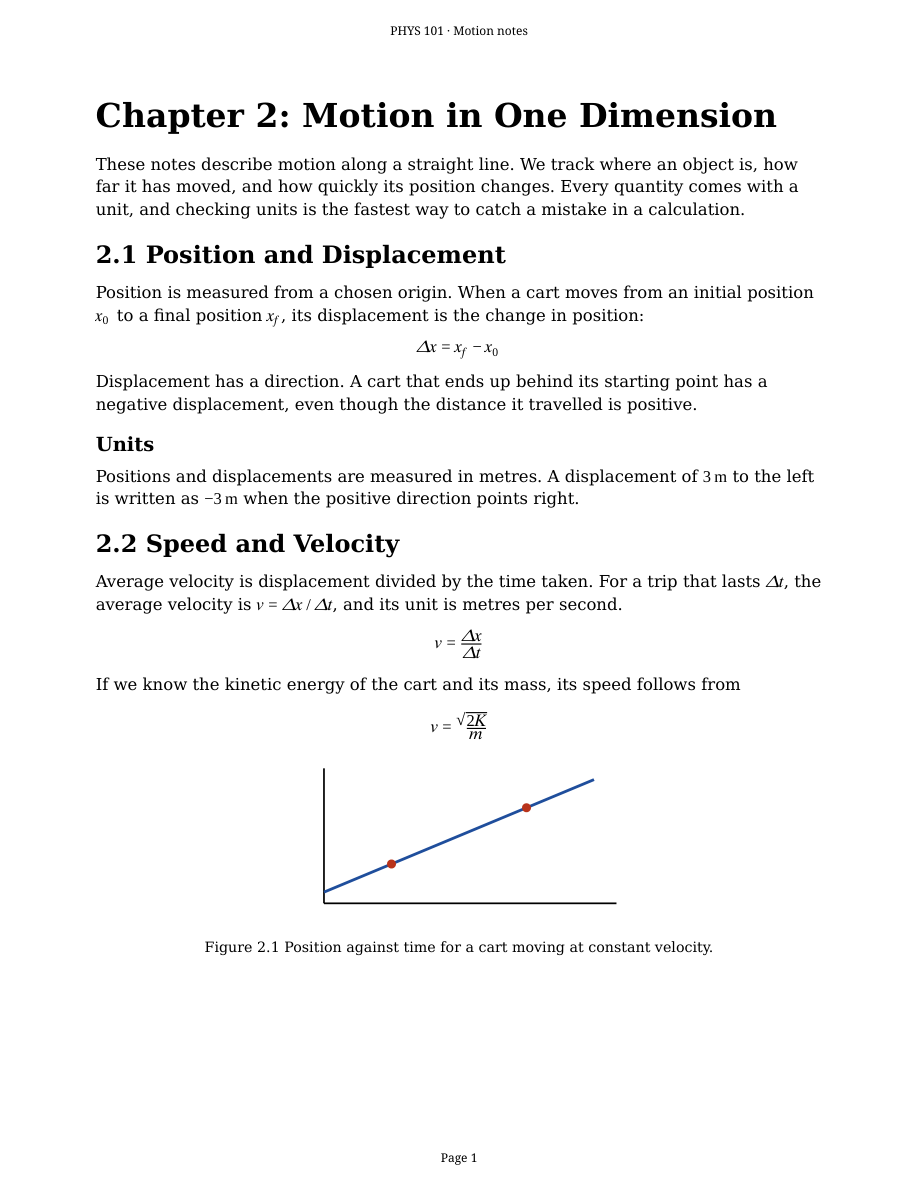
Converted HTML, page 1
Chapter 2: Motion in One Dimension
These notes describe motion along a straight line. We track where an object is, how far it has moved, and how quickly its position changes. Every quantity comes with a unit, and checking units is the fastest way to catch a mistake in a calculation.
2.1 Position and Displacement
Position is measured from a chosen origin. When a cart moves from an initial position to a final position , its displacement is the change in position:
Displacement has a direction. A cart that ends up behind its starting point has a negative displacement, even though the distance it travelled is positive.
Units
Positions and displacements are measured in metres. A displacement of 3 m to the left is written as when the positive direction points right.
2.2 Speed and Velocity
Average velocity is displacement divided by the time taken. For a trip that lasts , the average velocity is , and its unit is metres per second.
If we know the kinetic energy of the cart and its mass, its speed follows from
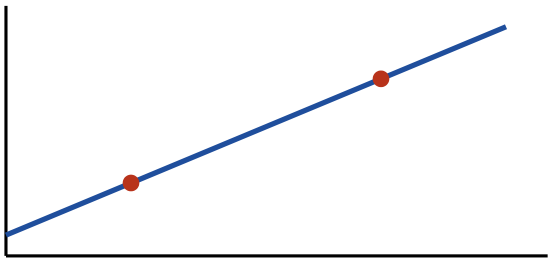
Page 2
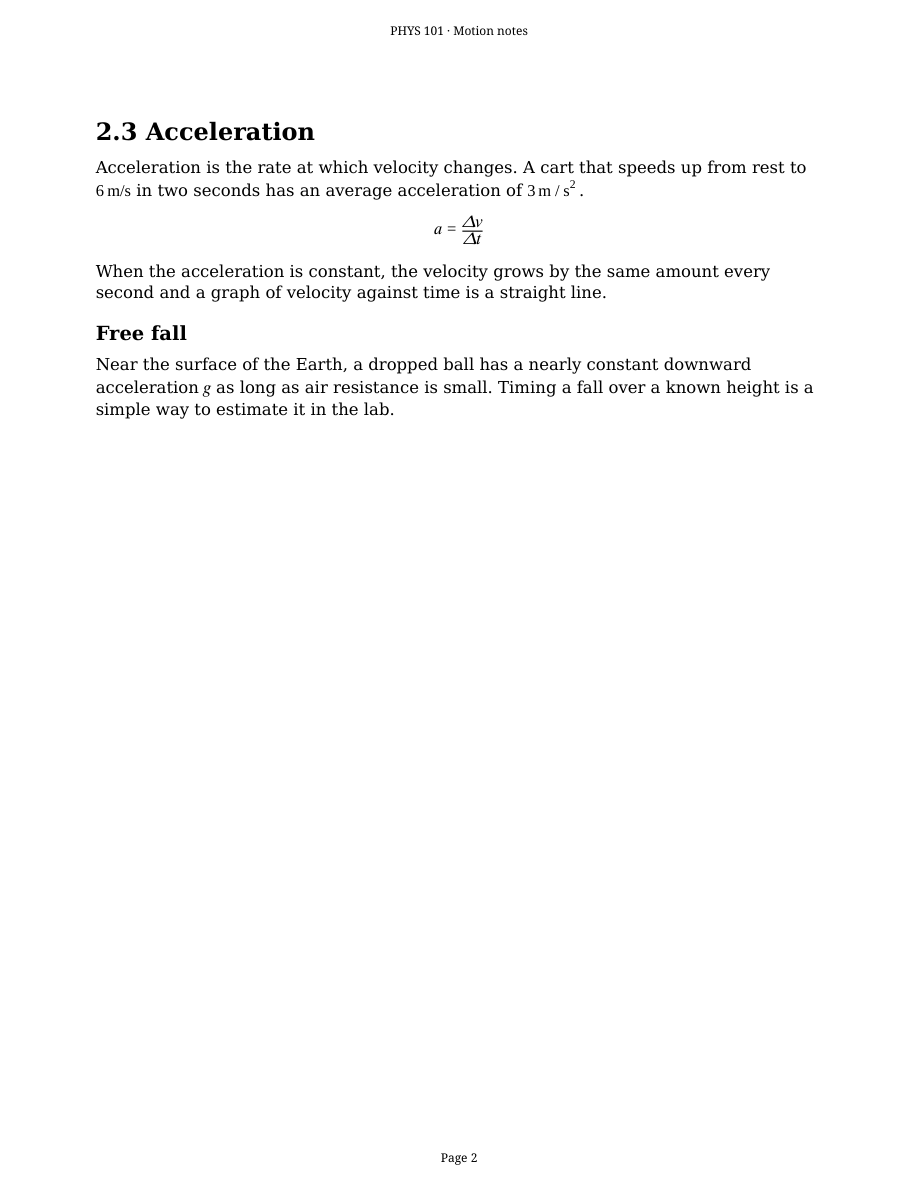
Converted HTML, page 2
2.3 Acceleration
Acceleration is the rate at which velocity changes. A cart that speeds up from rest to 6 m/s in two seconds has an average acceleration of .
When the acceleration is constant, the velocity grows by the same amount every second and a graph of velocity against time is a straight line.
Free fall
Near the surface of the Earth, a dropped ball has a nearly constant downward acceleration as long as air resistance is small. Timing a fall over a known height is a simple way to estimate it in the lab.
What the checks found
Two kinds of check run on every conversion. They find some problems. They do not show that a page is accessible.
Checks on the whole page
15 of 15 page rules passed. Show the list.
| Rule | Result |
|---|---|
| The page declares its language. | Passed |
| The page has a title. | Passed |
| There is exactly one main landmark. | Passed |
| No heading skips a level. | Passed |
| Every heading has text. | Passed |
| Every image has an alt attribute. | Passed |
| No id is used twice. | Passed |
| Lists contain only list items. | Passed |
| Every equation says whether it is inline or displayed. | Passed |
| Nothing is loaded from outside the file. | Passed |
| The tool's own notes make no claim of conformance. | Passed |
| Every link has text. | Passed |
| Every link goes somewhere safe. | Passed |
| Language tags are well formed. | Passed |
| Colored text has at least 4.5:1 contrast. | Passed |
The full axe-core test is run on the tool's own test documents in its test suite, not on each conversion shown here.
Checks on single items
Every item check passed.
Decisions a person would see
The app shows these on its review screen, one at a time, beside the page. Here they are as a static list. Each card has the original, the proposal, why the tool is asking, and what each choice would do.
-
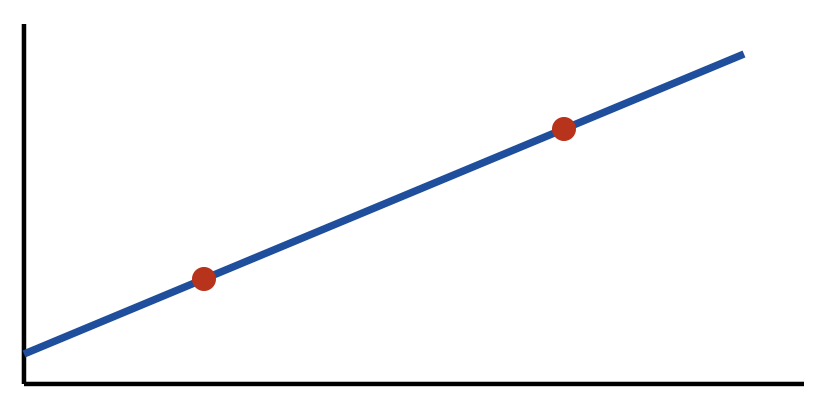
Figure 1
In the PDF
Proposed alt text
Line graph with unlabelled axes: a straight line rises steadily from a positive starting value, with two points marked on it, showing constant slope.
Why the tool is asking
- The model was not sure enough for the tool to accept this without a person looking at it.
What each choice does
- Accept. The alt text goes into the document.
- Edit the alt text. Write your own. It is checked again.
- Keep without a description. The figure stays, marked “Needs a description”; screen readers get no description.
How some equations are read aloud
Two readings of the same equation. “From the PDF's text” is the PDF's own text layer read by the tool's speech rules. “From the HTML” is the MathML read the same way. These are approximations, not recordings of a screen reader. See all of them with the printed equation.
| Equation | From the PDF's text | From the HTML |
|---|---|---|
| Page 1 | “v equals square root 2 cap K m” | “v equals the square root of 2 cap K over m end root” |
| Page 1 | “cap delta x equals x f minus x 0” | “cap delta x equals x sub f end sub minus x sub 0” |
| Page 2 | “a equals cap delta v cap delta t” | “a equals cap delta v over cap delta t” |
Files and credit
- The full converted HTML page (one self-contained file).
- The source PDF.
- The stored result (JSON): every item, its checks and its confidence.