Worked example
OpenStax Physics 2.1: Relative Motion, Distance, and Displacement
Bold displacement vectors with subscripts, and figures, converted with the Claude provider.
About this conversion
- Source
- Physics, section “2.1 Relative Motion, Distance, and Displacement”, by Paul Peter Urone, Roger Hinrichs, OpenStax. Original page.
- Set
- Development: one of the three sections used while the tool was built.
- Converted
- 2026-10-14, by pipeline version 0.5.0 with Claude (claude-haiku-5-5, claude-opus-5-5). 17 model calls, $0.073.
- What came out
- 16 PDF pages: 52 headings, 8 equations, 7 figures. 63 items were accepted without a question. 2 decisions were asked of a person, and 11 items carry an optional note.
The PDF as it came
- The PDF is not tagged, so it carries no structure for a screen reader.
- It declares no language. It has no bookmarks.
- 7 images; an untagged PDF cannot carry alt text for them.
- 8 equations were found. In 4 of them the text layer loses the structure (fractions, scripts, roots), so a screen reader gets a flat string.
Honest scope. These are the stored proposals as the tool made them. The review decisions below were never taken: this page shows what a person would be asked.
The PDF beside the HTML
Left, a page of the PDF as printed. Right, the HTML the tool made from that page, using the tool's own styles. The equations are MathML, so they are real text a screen reader can speak. Heading levels are shifted down in these excerpts so they nest under this page's own headings; the full converted page has the real levels. Open the full converted page, or listen to it as a student (roughly what a screen reader says).
Page 6
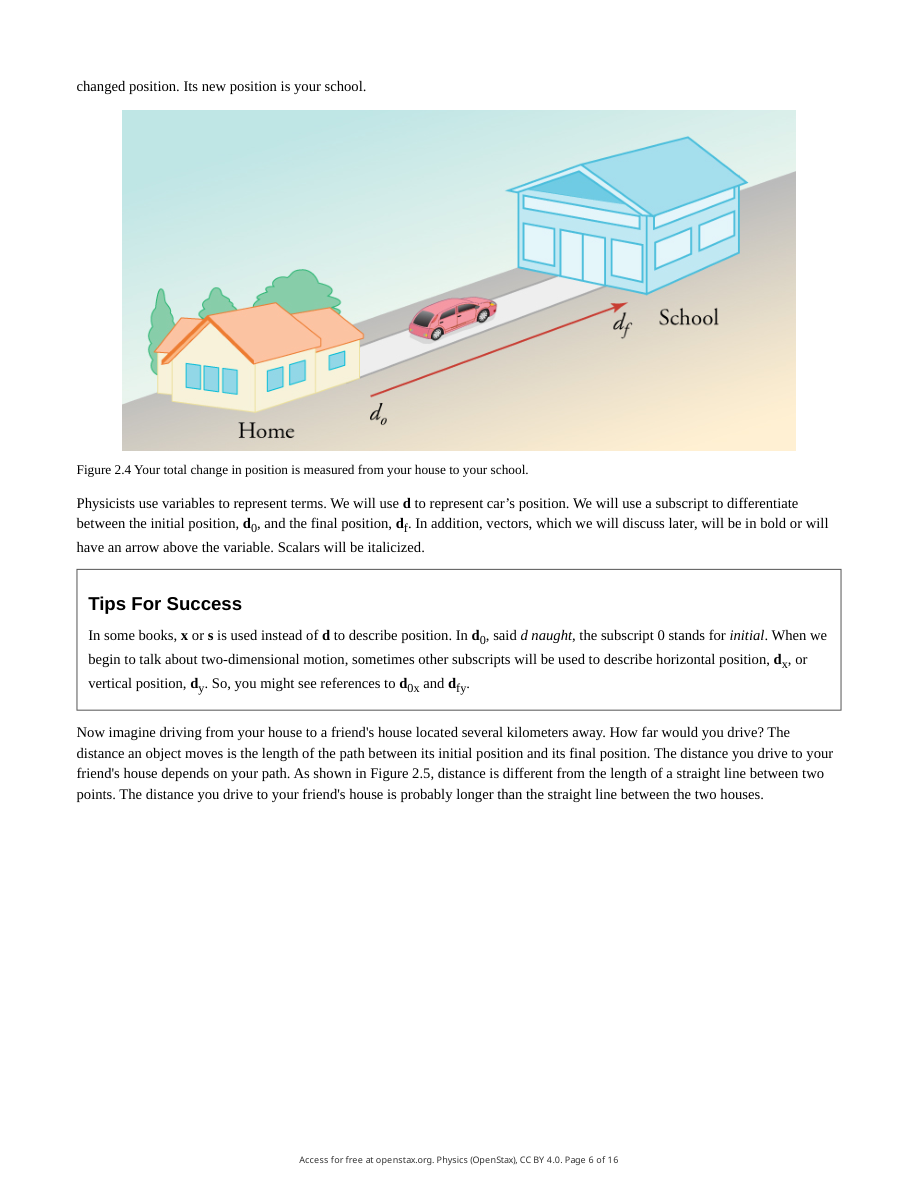
Converted HTML, page 6
changed position. Its new position is your school.
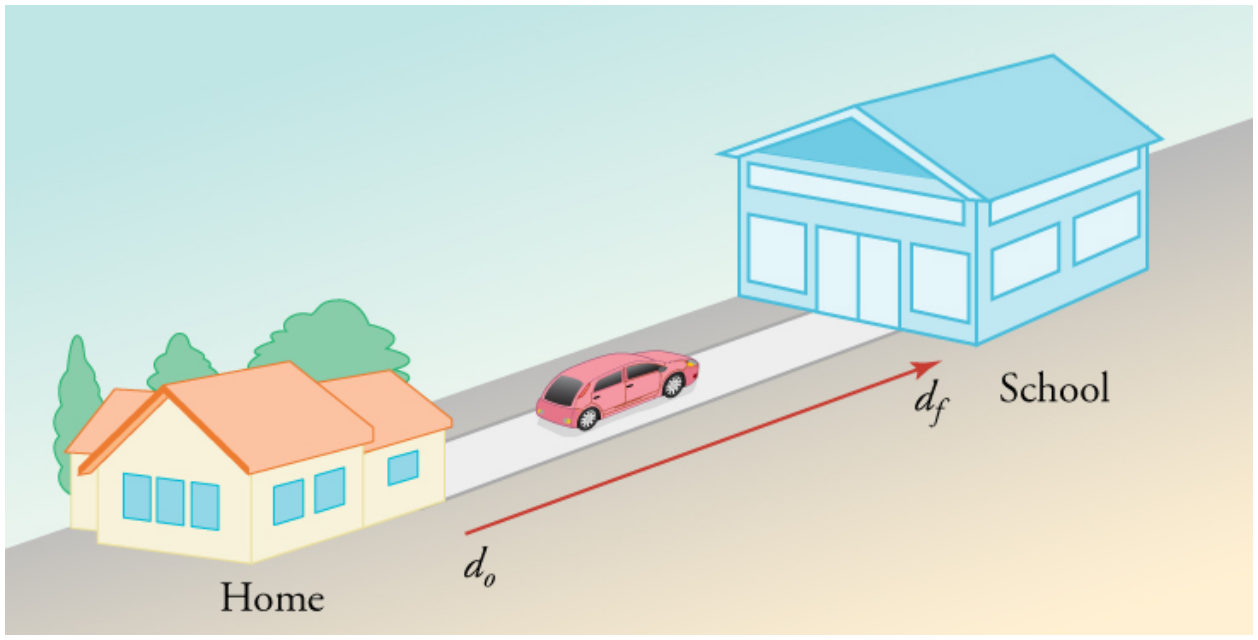
Physicists use variables to represent terms. We will use d to represent car’s position. We will use a subscript to differentiate between the initial position, d0, and the final position, df. In addition, vectors, which we will discuss later, will be in bold or will have an arrow above the variable. Scalars will be italicized.
Tips For Success
In some books, x or s is used instead of d to describe position. In d0, said d naught, the subscript 0 stands for initial. When we begin to talk about two-dimensional motion, sometimes other subscripts will be used to describe horizontal position, dx, or vertical position, dy. So, you might see references to d0x and dfy.
Now imagine driving from your house to a friend's house located several kilometers away. How far would you drive? The distance an object moves is the length of the path between its initial position and its final position. The distance you drive to your friend's house depends on your path. As shown in Figure 2.5, distance is different from the length of a straight line between two points. The distance you drive to your friend's house is probably longer than the straight line between the two houses.
Page 11
Converted HTML, page 11
Teacher Support
Teacher Support
Define the concepts of vectors and scalars before watching the video.
Come up with some examples of vectors and scalars and have the students classify each.
Discuss how the concept of direction might be important for the study of motion.
Displacement Problems
Hopefully you now understand the conceptual difference between distance and displacement. Understanding concepts is half the battle in physics. The other half is math. A stumbling block to new physics students is trying to wade through the math of physics while also trying to understand the associated concepts. This struggle may lead to misconceptions and answers that make no sense. Once the concept is mastered, the math is far less confusing.
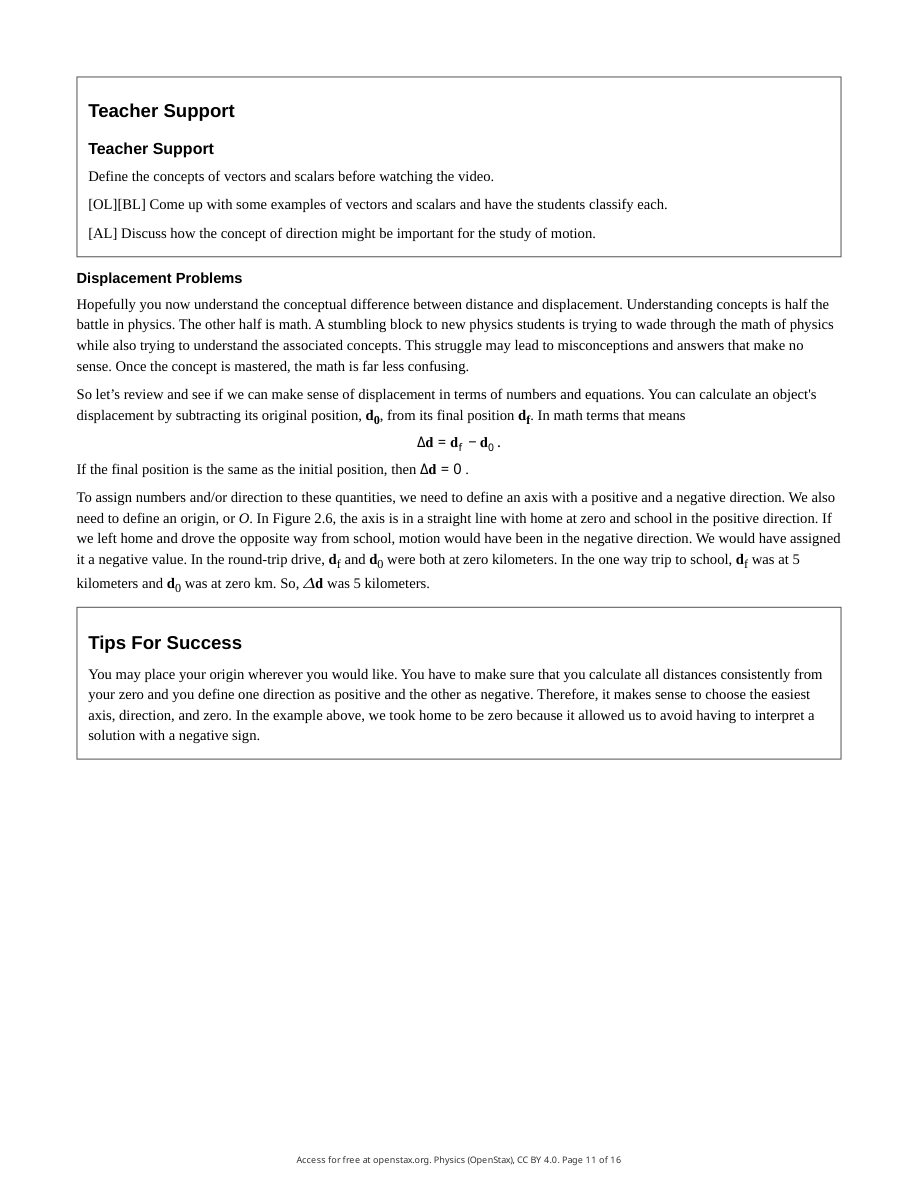
So let’s review and see if we can make sense of displacement in terms of numbers and equations. You can calculate an object's displacement by subtracting its original position, d0, from its final position df. In math terms that means
If the final position is the same as the initial position, then .
To assign numbers and/or direction to these quantities, we need to define an axis with a positive and a negative direction. We also need to define an origin, or O. In Figure 2.6, the axis is in a straight line with home at zero and school in the positive direction. If we left home and drove the opposite way from school, motion would have been in the negative direction. We would have assigned it a negative value. In the round-trip drive, df and d0 were both at zero kilometers. In the one way trip to school, df was at 5 kilometers and d0 was at zero km. So, was 5 kilometers.
Tips For Success
You may place your origin wherever you would like. You have to make sure that you calculate all distances consistently from your zero and you define one direction as positive and the other as negative. Therefore, it makes sense to choose the easiest axis, direction, and zero. In the example above, we took home to be zero because it allowed us to avoid having to interpret a solution with a negative sign.
What the checks found
Two kinds of check run on every conversion. They find some problems. They do not show that a page is accessible.
Checks on the whole page
15 of 15 page rules passed. Show the list.
| Rule | Result |
|---|---|
| The page declares its language. | Passed |
| The page has a title. | Passed |
| There is exactly one main landmark. | Passed |
| No heading skips a level. | Passed |
| Every heading has text. | Passed |
| Every image has an alt attribute. | Passed |
| No id is used twice. | Passed |
| Lists contain only list items. | Passed |
| Every equation says whether it is inline or displayed. | Passed |
| Nothing is loaded from outside the file. | Passed |
| The tool's own notes make no claim of conformance. | Passed |
| Every link has text. | Passed |
| Every link goes somewhere safe. | Passed |
| Language tags are well formed. | Passed |
| Colored text has at least 4.5:1 contrast. | Passed |
The full axe-core test is run on the tool's own test documents in its test suite, not on each conversion shown here.
Checks on single items
| What the check found | Items | Asked a person | Optional note | Accepted without a question |
|---|---|---|---|---|
| Only weak signs say this is a heading (bold at body size, no larger font or section number), so look at whether it is a label in the text, not a heading. (heading.evidence: heading.weak_evidence) | 12 | 4 | 8 | 0 |
| The alt text is long: aim for 150 characters or fewer (over 300 it cannot be saved). (alt.length: too_long) | 2 | 0 | 2 | 0 |
| The model read this equation once, and its answer passed every check, so no second reading was made and it was accepted as it stands. (equation.single_reading: single_reading) | 1 | 0 | 1 | 0 |
An item can fail more than one check, so the rows can add up to more than the number of items.
Notices about the document
- The language of the document was detected from its text, so look at whether it is right.
- A link's text does not say where it goes (for example, click here), so reword it.
Decisions a person would see
The app shows these on its review screen, one at a time, beside the page. Here they are as a static list. Each card has the original, the proposal, why the tool is asking, and what each choice would do.
-
Heading: “Procedure”, 2 times
In the PDF

Proposal
A heading at level 3: “Procedure”. One decision covers all 2.
Why the tool is asking
- Only weak signs say this is a heading (bold at body size, no larger font or section number), so look at whether it is a label in the text, not a heading.
What each choice does
- Keep as headings at level 3. They stay in the outline that a screen reader lists.
- Choose another level. Pick the level for all of them.
- Make bold text. It stays in bold but leaves the outline.
-
Heading: “Distance vs. Displacement”, 2 times
In the PDF

Proposal
A heading at level 3: “Distance vs. Displacement”. One decision covers all 2.
Why the tool is asking
- Only weak signs say this is a heading (bold at body size, no larger font or section number), so look at whether it is a label in the text, not a heading.
What each choice does
- Keep as headings at level 3. They stay in the outline that a screen reader lists.
- Choose another level. Pick the level for all of them.
- Make bold text. It stays in bold but leaves the outline.
Optional notes
These items were accepted. The tool left a note for a person who wants to look.
- Equation 1, page 7: The model read this equation once, and its answer passed every check, so no second reading was made and it was accepted as it stands.
- Figure 5, page 7: The alt text is long: aim for 150 characters or fewer (over 300 it cannot be saved).
- Figure 7, page 14: The alt text is long: aim for 150 characters or fewer (over 300 it cannot be saved).
- Heading 14, page 4: Only weak signs say this is a heading (bold at body size, no larger font or section number), so look at whether it is a label in the text, not a heading.
- Heading 20, page 5: Only weak signs say this is a heading (bold at body size, no larger font or section number), so look at whether it is a label in the text, not a heading.
- Heading 32, page 10: Only weak signs say this is a heading (bold at body size, no larger font or section number), so look at whether it is a label in the text, not a heading.
- Heading 35, page 11: Only weak signs say this is a heading (bold at body size, no larger font or section number), so look at whether it is a label in the text, not a heading.
- Heading 38, page 12: Only weak signs say this is a heading (bold at body size, no larger font or section number), so look at whether it is a label in the text, not a heading.
- Heading 40, page 12: Only weak signs say this is a heading (bold at body size, no larger font or section number), so look at whether it is a label in the text, not a heading.
- Heading 41, page 13: Only weak signs say this is a heading (bold at body size, no larger font or section number), so look at whether it is a label in the text, not a heading.
- Heading 47, page 14: Only weak signs say this is a heading (bold at body size, no larger font or section number), so look at whether it is a label in the text, not a heading.
How some equations are read aloud
Two readings of the same equation. “From the PDF's text” is the PDF's own text layer read by the tool's speech rules. “From the HTML” is the MathML read the same way. These are approximations, not recordings of a screen reader. See all of them with the printed equation.
| Equation | From the PDF's text | From the HTML |
|---|---|---|
| Page 11 | “cap delta bold d equals 0” | “cap delta bold d equals 0” |
| Page 12 | “cap delta bold d equals bold d f minus bold d 0 equals minus 1 k m” | “cap delta bold d equals bold d sub f end sub minus bold d sub 0 equals minus 1 kilometer” |
Files and credit
- The full converted HTML page (one self-contained file).
- The source PDF, printed from the OpenStax web page by this project.
- The stored result (JSON): every item, its checks and its confidence.
“2.1 Relative Motion, Distance, and Displacement” from Physics by Paul Peter Urone, Roger Hinrichs, OpenStax, is under Creative Commons Attribution License (CC BY 4.0). Changes: printed to PDF, converted by ReadableSTEM, and shown here with review notes. Wording was not edited. Some figures in OpenStax books carry their own credits. All credits.