Worked example
OpenStax Physics 2.2: Speed and Velocity
Fractions, subscripts and long worked equations, converted with the Claude provider.
About this conversion
- Source
- Physics, section “2.2 Speed and Velocity”, by Paul Peter Urone, Roger Hinrichs, OpenStax. Original page.
- Set
- Development: one of the three sections used while the tool was built.
- Converted
- 2026-10-14, by pipeline version 0.5.0 with Claude (claude-haiku-5-5, claude-opus-5-5). 18 model calls, $0.068.
- What came out
- 14 PDF pages: 50 headings, 15 equations, 2 figures. 59 items were accepted without a question. 2 decisions were asked of a person, and 10 items carry an optional note.
The PDF as it came
- The PDF is not tagged, so it carries no structure for a screen reader.
- It declares no language. It has no bookmarks.
- 2 images; an untagged PDF cannot carry alt text for them.
- 15 equations were found. In 12 of them the text layer loses the structure (fractions, scripts, roots), so a screen reader gets a flat string.
Honest scope. These are the stored proposals as the tool made them. The review decisions below were never taken: this page shows what a person would be asked.
The PDF beside the HTML
Left, a page of the PDF as printed. Right, the HTML the tool made from that page, using the tool's own styles. The equations are MathML, so they are real text a screen reader can speak. Heading levels are shifted down in these excerpts so they nest under this page's own headings; the full converted page has the real levels. Open the full converted page, or listen to it as a student (roughly what a screen reader says).
Page 2
Converted HTML, page 2
Teacher Support
Teacher Support
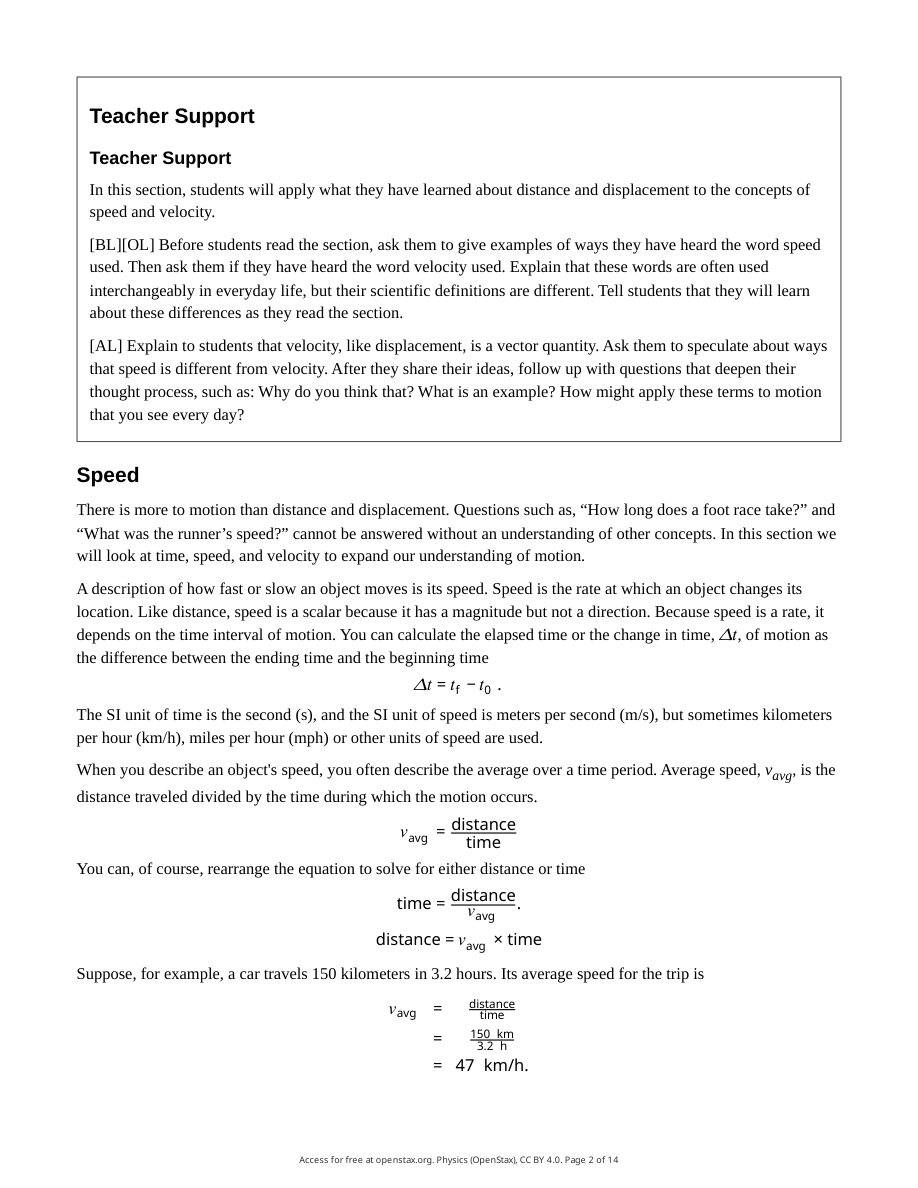
In this section, students will apply what they have learned about distance and displacement to the concepts of speed and velocity.
Before students read the section, ask them to give examples of ways they have heard the word speed used. Then ask them if they have heard the word velocity used. Explain that these words are often used interchangeably in everyday life, but their scientific definitions are different. Tell students that they will learn about these differences as they read the section.
Explain to students that velocity, like displacement, is a vector quantity. Ask them to speculate about ways that speed is different from velocity. After they share their ideas, follow up with questions that deepen their thought process, such as: Why do you think that? What is an example? How might apply these terms to motion that you see every day?
Speed
There is more to motion than distance and displacement. Questions such as, “How long does a foot race take?” and “What was the runner’s speed?” cannot be answered without an understanding of other concepts. In this section we will look at time, speed, and velocity to expand our understanding of motion.
A description of how fast or slow an object moves is its speed. Speed is the rate at which an object changes its location. Like distance, speed is a scalar because it has a magnitude but not a direction. Because speed is a rate, it depends on the time interval of motion. You can calculate the elapsed time or the change in time, , of motion as the difference between the ending time and the beginning time
The SI unit of time is the second (s), and the SI unit of speed is meters per second (m/s), but sometimes kilometers per hour (km/h), miles per hour (mph) or other units of speed are used.
When you describe an object's speed, you often describe the average over a time period. Average speed, , is the distance traveled divided by the time during which the motion occurs.
You can, of course, rearrange the equation to solve for either distance or time
.
Suppose, for example, a car travels 150 kilometers in 3.2 hours. Its average speed for the trip is
Page 5
Converted HTML, page 5
10 . Cassie walked to her friend’s house with an average speed of 1.40 m/s. The distance between the houses is 205 m. How long did the trip take her?
- 146 s
- 0.01 s
- 2.50 min
- 287 s
Velocity
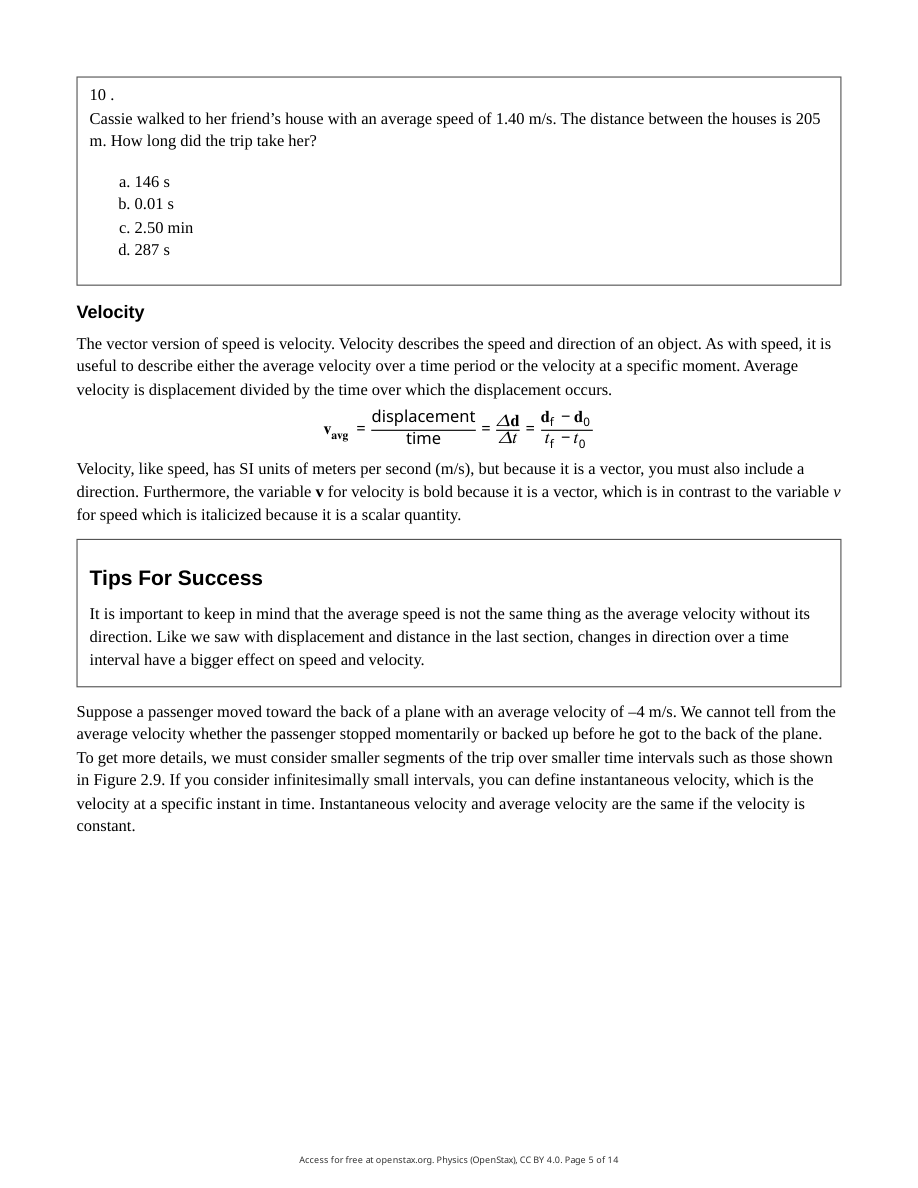
The vector version of speed is velocity. Velocity describes the speed and direction of an object. As with speed, it is useful to describe either the average velocity over a time period or the velocity at a specific moment. Average velocity is displacement divided by the time over which the displacement occurs.
Velocity, like speed, has SI units of meters per second (m/s), but because it is a vector, you must also include a direction. Furthermore, the variable v for velocity is bold because it is a vector, which is in contrast to the variable v for speed which is italicized because it is a scalar quantity.
Tips For Success
It is important to keep in mind that the average speed is not the same thing as the average velocity without its direction. Like we saw with displacement and distance in the last section, changes in direction over a time interval have a bigger effect on speed and velocity.
Suppose a passenger moved toward the back of a plane with an average velocity of –4 m/s. We cannot tell from the average velocity whether the passenger stopped momentarily or backed up before he got to the back of the plane. To get more details, we must consider smaller segments of the trip over smaller time intervals such as those shown in Figure 2.9. If you consider infinitesimally small intervals, you can define instantaneous velocity, which is the velocity at a specific instant in time. Instantaneous velocity and average velocity are the same if the velocity is constant.
Page 10
Converted HTML, page 10
Worked Example
Solving for Displacement when Average Velocity and Time are Known
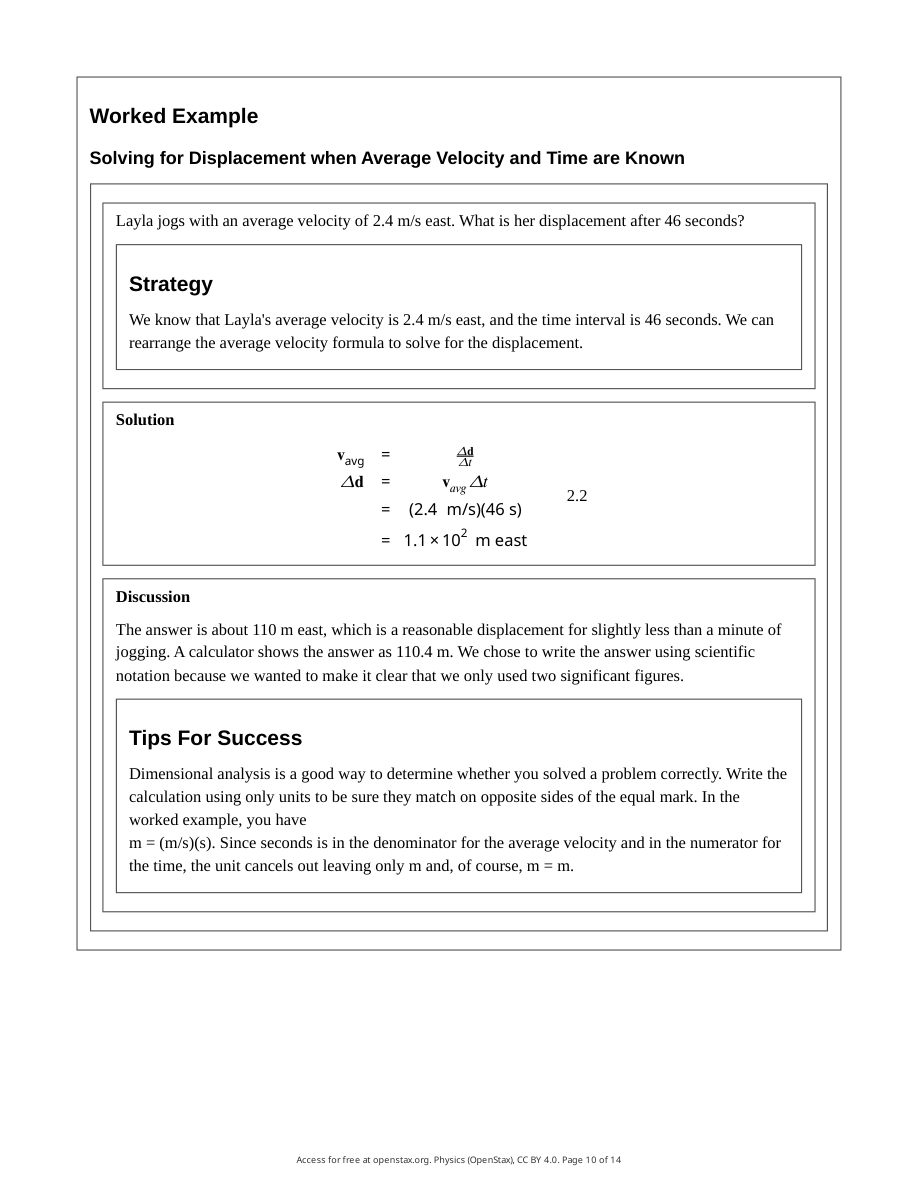
Layla jogs with an average velocity of 2.4 m/s east. What is her displacement after 46 seconds?
Strategy
We know that Layla's average velocity is 2.4 m/s east, and the time interval is 46 seconds. We can rearrange the average velocity formula to solve for the displacement.
Solution
Discussion
The answer is about 110 m east, which is a reasonable displacement for slightly less than a minute of jogging. A calculator shows the answer as 110.4 m. We chose to write the answer using scientific notation because we wanted to make it clear that we only used two significant figures.
Tips For Success
Dimensional analysis is a good way to determine whether you solved a problem correctly. Write the calculation using only units to be sure they match on opposite sides of the equal mark. In the worked example, you have . Since seconds is in the denominator for the average velocity and in the numerator for the time, the unit cancels out leaving only m and, of course, .
What the checks found
Two kinds of check run on every conversion. They find some problems. They do not show that a page is accessible.
Checks on the whole page
15 of 15 page rules passed. Show the list.
| Rule | Result |
|---|---|
| The page declares its language. | Passed |
| The page has a title. | Passed |
| There is exactly one main landmark. | Passed |
| No heading skips a level. | Passed |
| Every heading has text. | Passed |
| Every image has an alt attribute. | Passed |
| No id is used twice. | Passed |
| Lists contain only list items. | Passed |
| Every equation says whether it is inline or displayed. | Passed |
| Nothing is loaded from outside the file. | Passed |
| The tool's own notes make no claim of conformance. | Passed |
| Every link has text. | Passed |
| Every link goes somewhere safe. | Passed |
| Language tags are well formed. | Passed |
| Colored text has at least 4.5:1 contrast. | Passed |
The full axe-core test is run on the tool's own test documents in its test suite, not on each conversion shown here.
Checks on single items
| What the check found | Items | Asked a person | Optional note | Accepted without a question |
|---|---|---|---|---|
| Only weak signs say this is a heading (bold at body size, no larger font or section number), so look at whether it is a label in the text, not a heading. (heading.evidence: heading.weak_evidence) | 15 | 8 | 7 | 0 |
| The model read this equation once, and its answer passed every check, so no second reading was made and it was accepted as it stands. (equation.single_reading: single_reading) | 2 | 0 | 2 | 0 |
| The alt text is long: aim for 150 characters or fewer (over 300 it cannot be saved). (alt.length: too_long) | 1 | 0 | 1 | 0 |
An item can fail more than one check, so the rows can add up to more than the number of items.
Notices about the document
- The language of the document was detected from its text, so look at whether it is right.
- A link's text does not say where it goes (for example, click here), so reword it.
Decisions a person would see
The app shows these on its review screen, one at a time, beside the page. Here they are as a static list. Each card has the original, the proposal, why the tool is asking, and what each choice would do.
-
Heading: “Solution”, 4 times
In the PDF

Proposal
A heading at level 3: “Solution”. One decision covers all 4.
Why the tool is asking
- Only weak signs say this is a heading (bold at body size, no larger font or section number), so look at whether it is a label in the text, not a heading.
What each choice does
- Keep as headings at level 3. They stay in the outline that a screen reader lists.
- Choose another level. Pick the level for all of them.
- Make bold text. It stays in bold but leaves the outline.
-
Heading: “Discussion”, 4 times
In the PDF

Proposal
A heading at level 3: “Discussion”. One decision covers all 4.
Why the tool is asking
- Only weak signs say this is a heading (bold at body size, no larger font or section number), so look at whether it is a label in the text, not a heading.
What each choice does
- Keep as headings at level 3. They stay in the outline that a screen reader lists.
- Choose another level. Pick the level for all of them.
- Make bold text. It stays in bold but leaves the outline.
Optional notes
These items were accepted. The tool left a note for a person who wants to look.
- Equation 10, page 7: The model read this equation once, and its answer passed every check, so no second reading was made and it was accepted as it stands.
- Equation 13, page 10: The model read this equation once, and its answer passed every check, so no second reading was made and it was accepted as it stands.
- Figure 1, page 3: The alt text is long: aim for 150 characters or fewer (over 300 it cannot be saved).
- Heading 12, page 4: Only weak signs say this is a heading (bold at body size, no larger font or section number), so look at whether it is a label in the text, not a heading.
- Heading 17, page 5: Only weak signs say this is a heading (bold at body size, no larger font or section number), so look at whether it is a label in the text, not a heading.
- Heading 20, page 7: Only weak signs say this is a heading (bold at body size, no larger font or section number), so look at whether it is a label in the text, not a heading.
- Heading 24, page 8: Only weak signs say this is a heading (bold at body size, no larger font or section number), so look at whether it is a label in the text, not a heading.
- Heading 32, page 10: Only weak signs say this is a heading (bold at body size, no larger font or section number), so look at whether it is a label in the text, not a heading.
- Heading 38, page 11: Only weak signs say this is a heading (bold at body size, no larger font or section number), so look at whether it is a label in the text, not a heading.
- Heading 44, page 12: Only weak signs say this is a heading (bold at body size, no larger font or section number), so look at whether it is a label in the text, not a heading.
How some equations are read aloud
Two readings of the same equation. “From the PDF's text” is the PDF's own text layer read by the tool's speech rules. “From the HTML” is the MathML read the same way. These are approximations, not recordings of a screen reader. See all of them with the printed equation.
| Equation | From the PDF's text | From the HTML |
|---|---|---|
| Page 2 | “d i s t a n c e v a v g equals t i m e equals 150 k m 3 period 2 h equals 47 k m divided by h” | “row 1: v sub avg equals distance over time; row 2: equals 150 kilometers over 3.2 hours; row 3: equals 47 kilometers per hour” |
| Page 5 | “bold v bold a bold v bold g equals d i s p l a c e m e n t equals cap delta bold d t i m e cap delta t equals bold d f minus bold d 0 t f minus t 0” | “bold v sub bold a bold v bold g end sub equals displacement over time equals cap delta bold d over cap delta t equals the fraction bold d sub f end sub minus bold d sub 0 end sub over t sub f end sub minus t sub 0 end sub end fraction” |
| Page 10 | “cap delta bold d bold v a v g equals cap delta t cap delta bold d equals bold v a v g cap delta t equals open parenthesis 2 period 4 m divided by s close parenthesis open parenthesis 46 s close parenthesis equals 1 period 1 times 102 m e a s t” | “row 1: bold v sub avg equals cap delta bold d over cap delta t; row 2: cap delta bold d equals bold v sub a v g end sub cap delta t; row 3: equals open parenthesis 2.4 meters per second close parenthesis open parenthesis 46 seconds close parenthesis; row 4: equals 1.1 times 10 squared m east” |
Files and credit
- The full converted HTML page (one self-contained file).
- The source PDF, printed from the OpenStax web page by this project.
- The stored result (JSON): every item, its checks and its confidence.
“2.2 Speed and Velocity” from Physics by Paul Peter Urone, Roger Hinrichs, OpenStax, is under Creative Commons Attribution License (CC BY 4.0). Changes: printed to PDF, converted by ReadableSTEM, and shown here with review notes. Wording was not edited. Some figures in OpenStax books carry their own credits. All credits.